
DataComp Image-Text Filtering
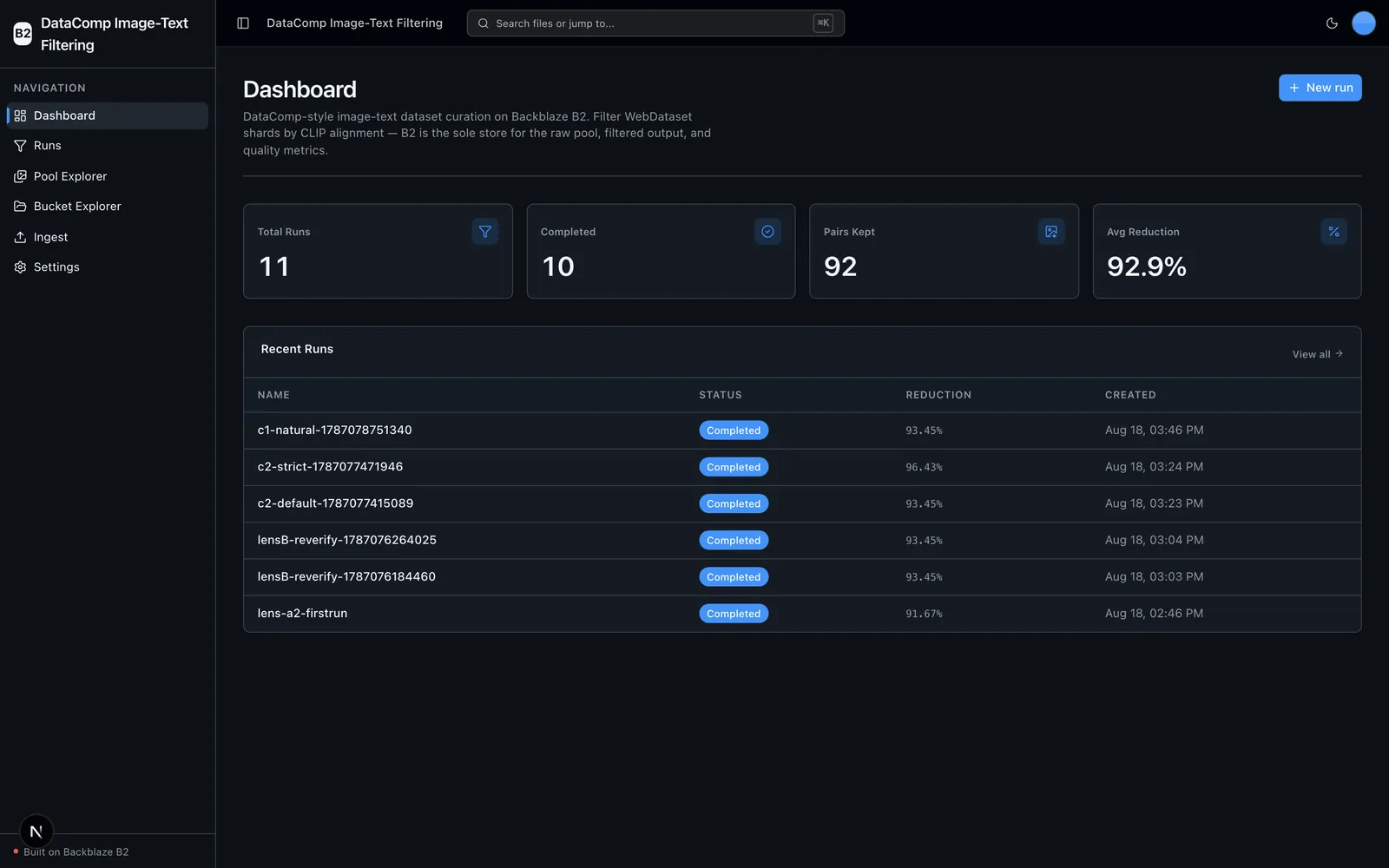
DataComp-style image-text dataset filtering on Backblaze B2: stream WebDataset shards from object storage, score image-text alignment with CLIP, and write filtered shards plus quality metrics back to B2 — no local staging, no database. Full-stack Next.js + FastAPI sample for VLM-pretraining data curation.
Built for: ML engineers and data curators building vision-language-model pretraining datasets, and teams evaluating Backblaze B2 as the storage layer for large-scale data curation.
What it's built with
Each piece of the stack, and the job it does in this project.
- Next.js 16 + React 19
- Frontend — App Router, Tailwind v4, shadcn/ui
- FastAPI
- Python 3.12 backend with a strict layered architecture
- open_clip (CLIP ViT-B-32)
- On-device image-text alignment scoring engine
- WebDataset
- .tar shard format streamed from and written back to B2
- Backblaze B2
- Sole storage layer via the S3-compatible API
Core capabilities
What the project does out of the box, before you write any code of your own.
DataComp-style CLIP-score filtering
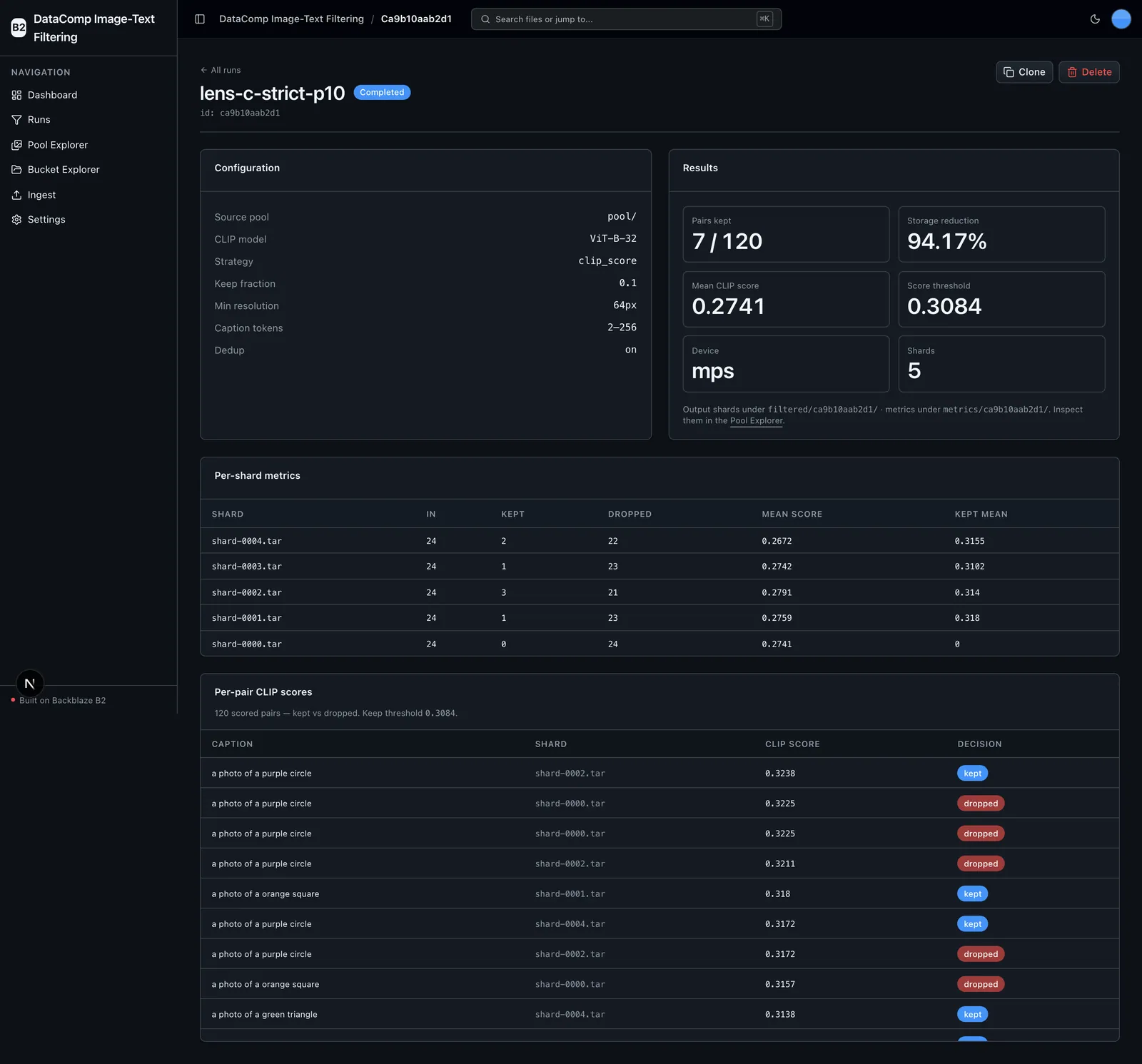
Stream shards from B2, score image-text alignment with CLIP, and keep the top-percentile pairs (DataComp's clip_score baseline).
Configurable baseline filters
CLIP-score percentile, min image resolution, caption-length bounds, and near-duplicate removal — the clip_score / basic / image_based / text_based families, chosen on the Run form.
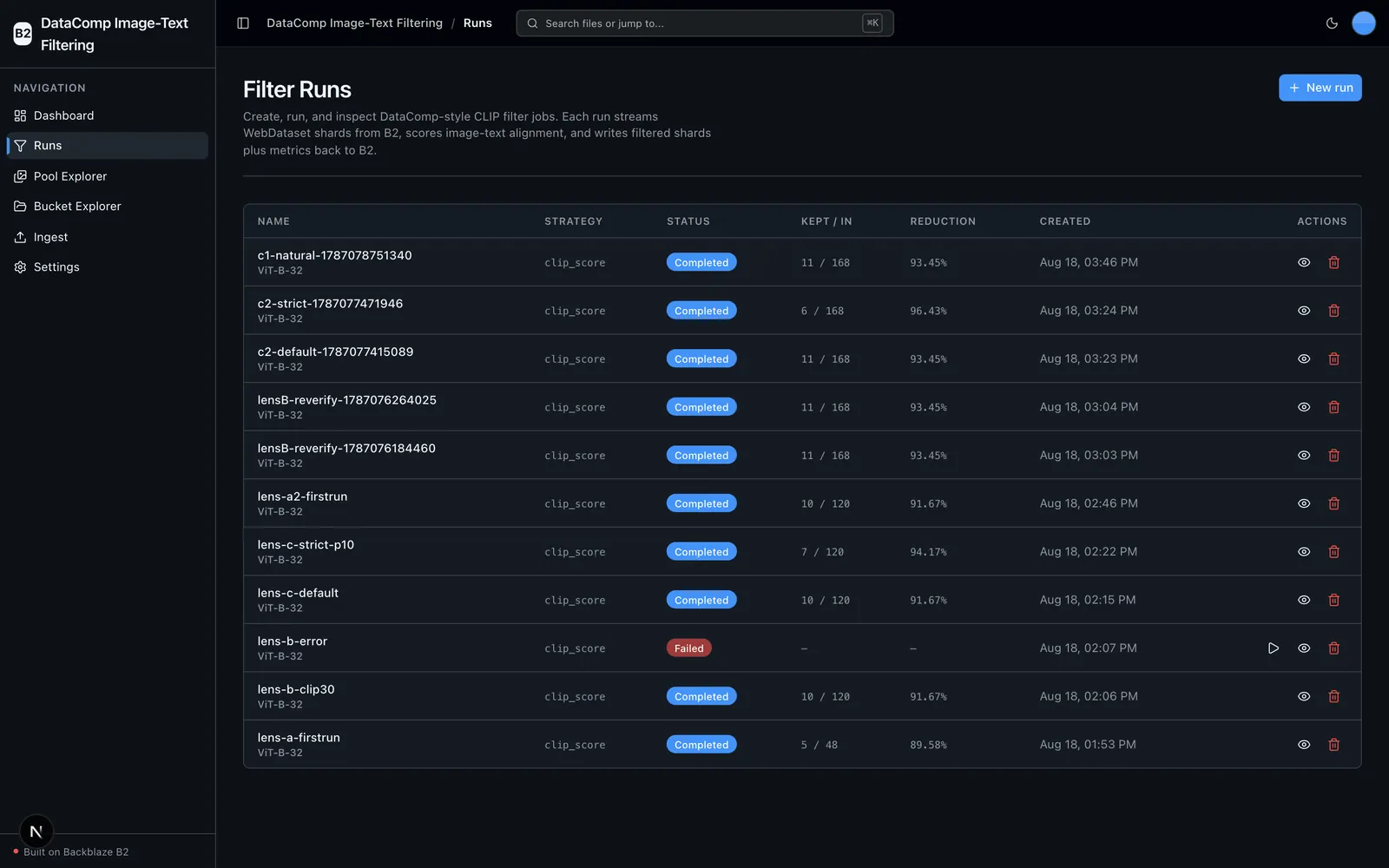
Filter Runs, full lifecycle in the UI
Create, read, edit, delete, and run filter jobs. B2 manifests are the sole store — no database.
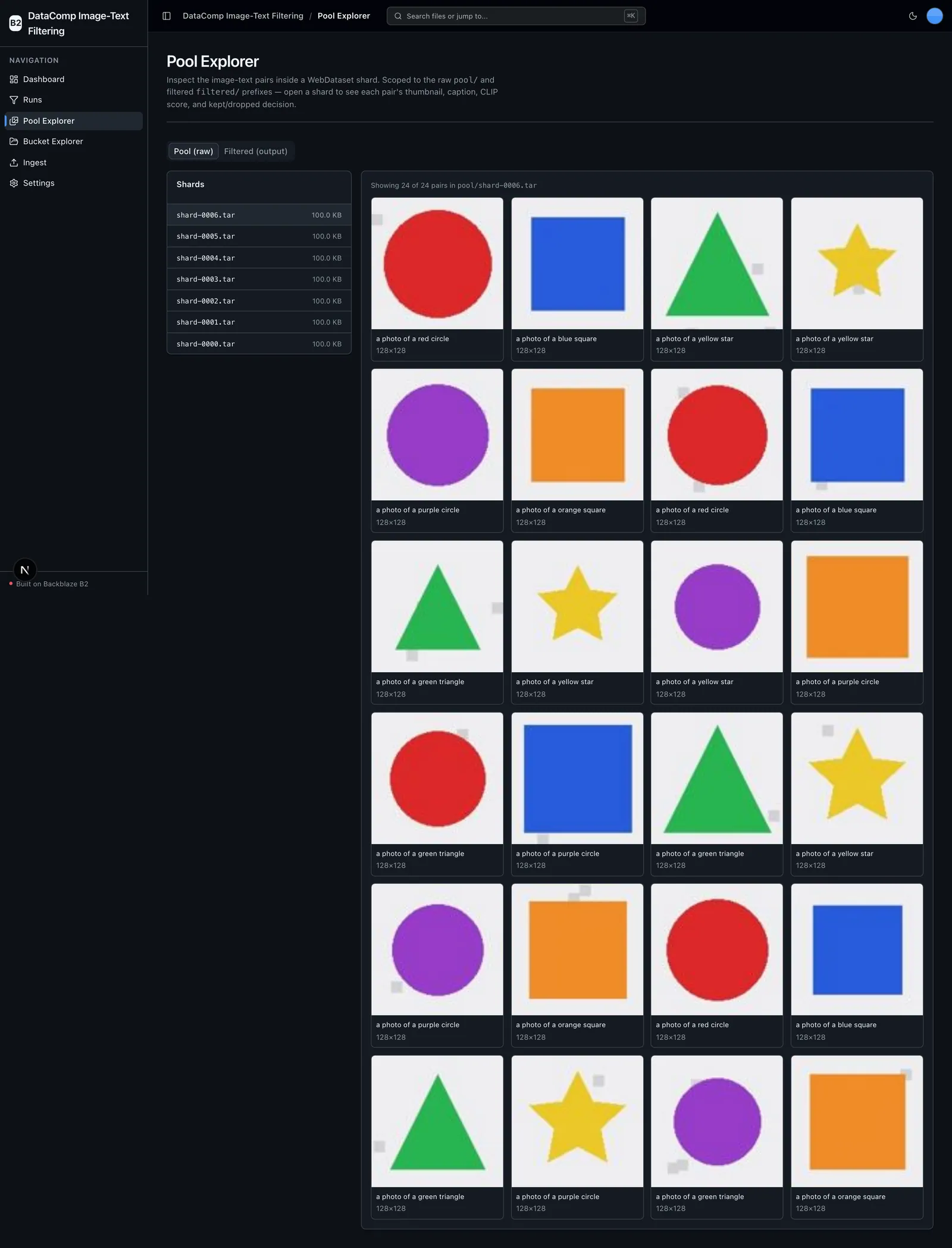
Pool Explorer
Open a WebDataset shard to inspect the image-text pairs inside it: thumbnail, caption, CLIP score, and kept/dropped.
Bucket Explorer
Browse every object in the bucket (pool, filtered, manifests, metrics) with preview, download, and delete.
A closer look
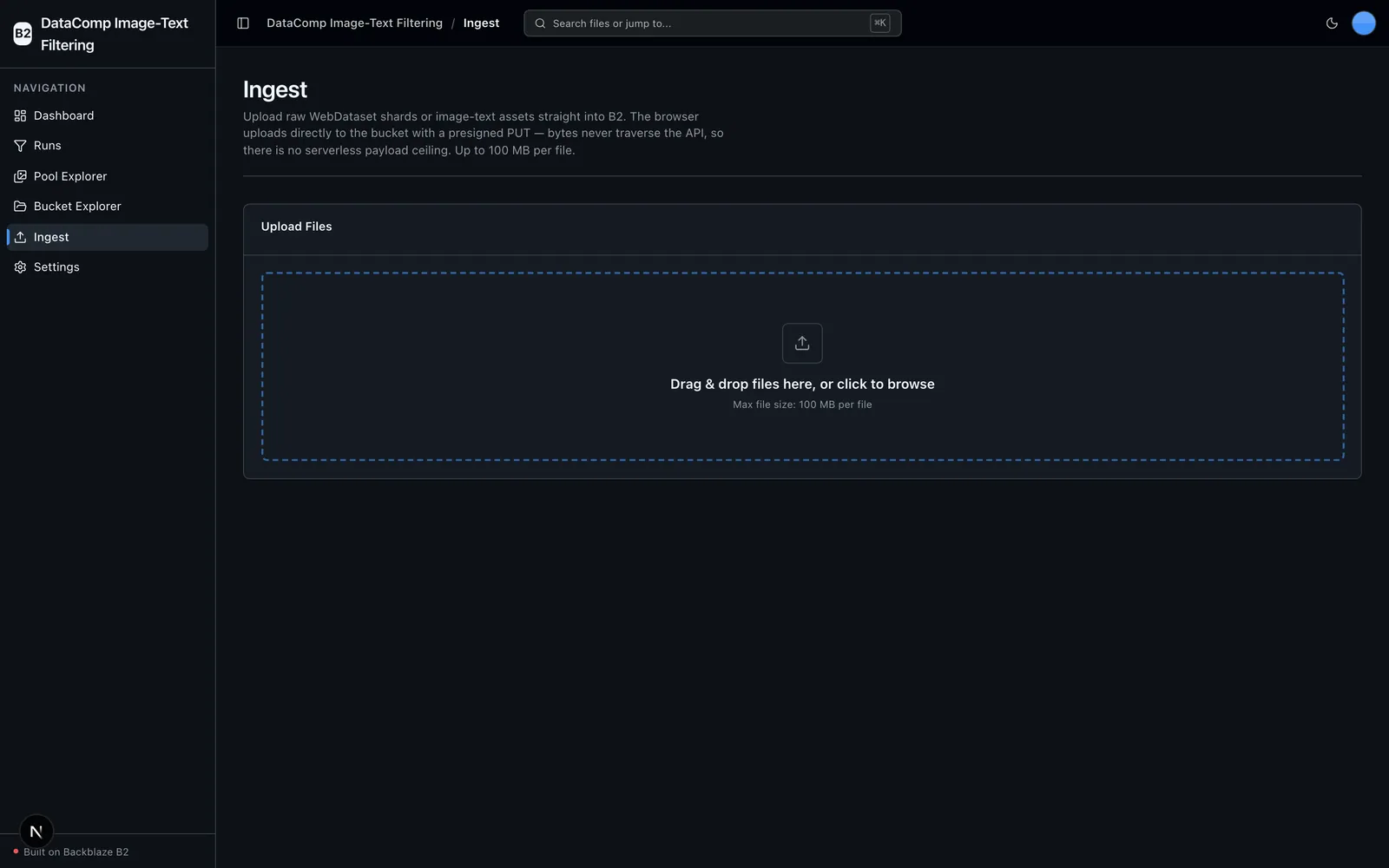
More screens from the running project.
Choose it for the right job
DataComp Image-Text Filtering is a head start for a specific shape of project, not a supported, general-purpose product.
Use it when
- You want a working reference for a DataComp-style CLIP-score filtering pipeline that streams WebDataset shards from object storage.
- You want to run real CLIP scoring over an image-text pool and inspect which pairs were kept vs dropped and why.
- You're evaluating Backblaze B2 as the sole storage layer for vision-language-model pretraining data curation — no database.
Choose another path when
- You need petabyte-scale throughput as-is — the demo holds each shard in memory; production would stream via WebDataset's S3 reader and run the engine on a GPU fleet.
- You need multi-tenant access control — the UI is unauthenticated and operates bucket-wide (single-tenant demo).
Project status and support
Community sample with no SLA — file issues on the GitHub repository, but support is best-effort only.