
LiveKit Agent Session Archive
Voice-agent session archive (Next.js 16 + FastAPI) where LiveKit Egress records each session straight to Backblaze B2 through the S3-compatible API, signed webhooks keep a per-session manifest current, faster-whisper transcribes and scores the recording locally, and a retention job keeps or removes sessions by class.
Built for: AI engineers running LiveKit Agents who want recordings, transcripts and evaluation results in one durable, inexpensive, S3-compatible store with a retention story, and AI coding agents extending the repository.
What it's built with
Each piece of the stack, and the job it does in this project.
- Next.js 16 + React 19
- Web dashboard UI
- Tailwind CSS v4 + shadcn/ui + TanStack Query
- Design tokens, interface primitives and data fetching
- livekit-client
- Join a session room from the browser with a microphone
- LiveKit server + Egress + Redis (Docker Compose)
- Rooms, media and audio-only recording uploaded straight to B2
- LiveKit Agents
- Scripted test agent that speaks in each room
- FastAPI (Python 3.12) + livekit-api
- REST API, signed webhook receiver and retention job
- boto3 + Backblaze B2
- S3-compatible storage for recordings, manifests, transcripts, evaluations and reports
- faster-whisper (tiny.en)
- Local CPU transcription, no hosted speech provider
Core capabilities
What the project does out of the box, before you write any code of your own.
Session recording
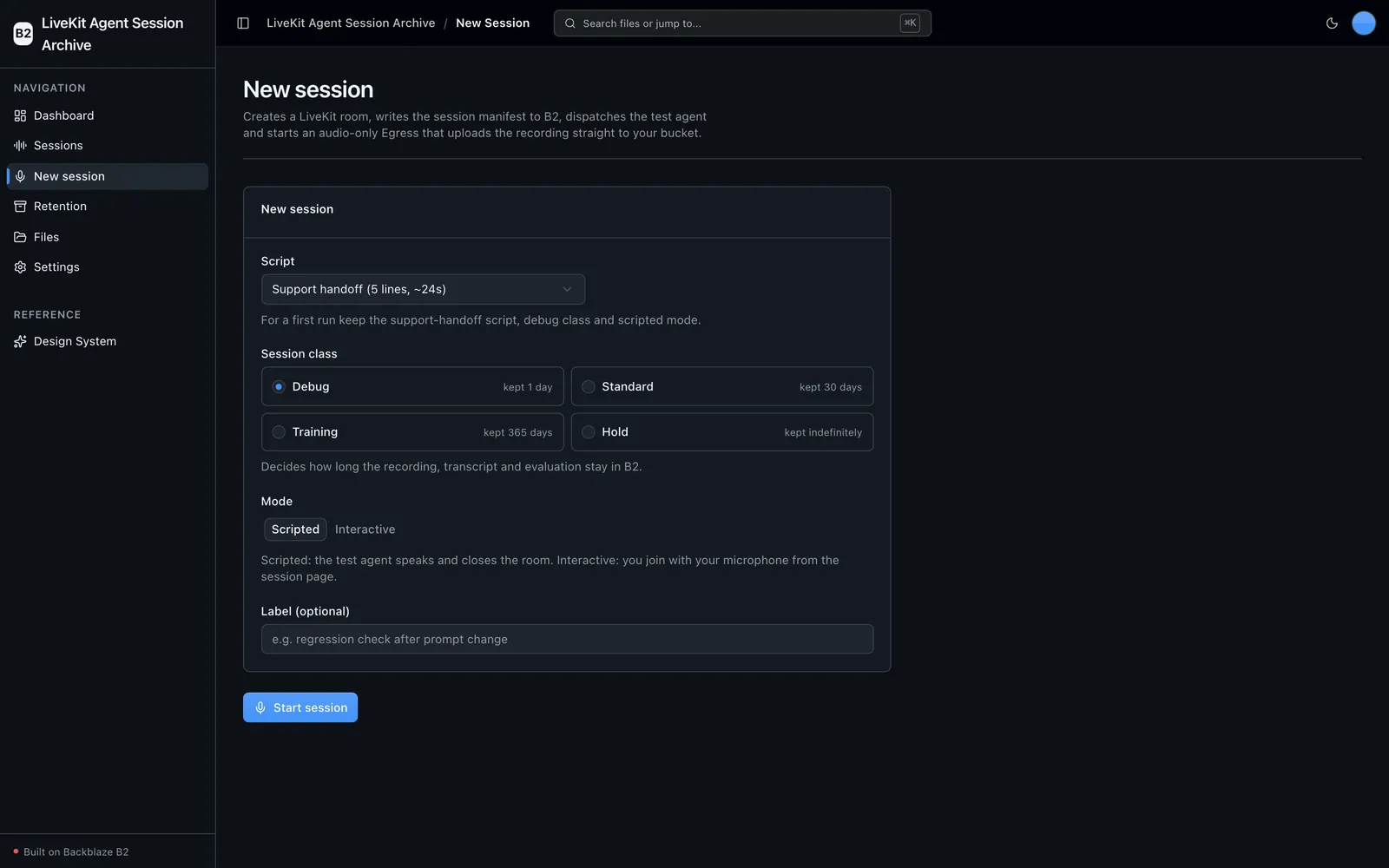
Create a room, dispatch the scripted test agent, and have LiveKit Egress record the session straight to B2 with its own S3-compatible uploader. The API never re-uploads a recording.
Session library
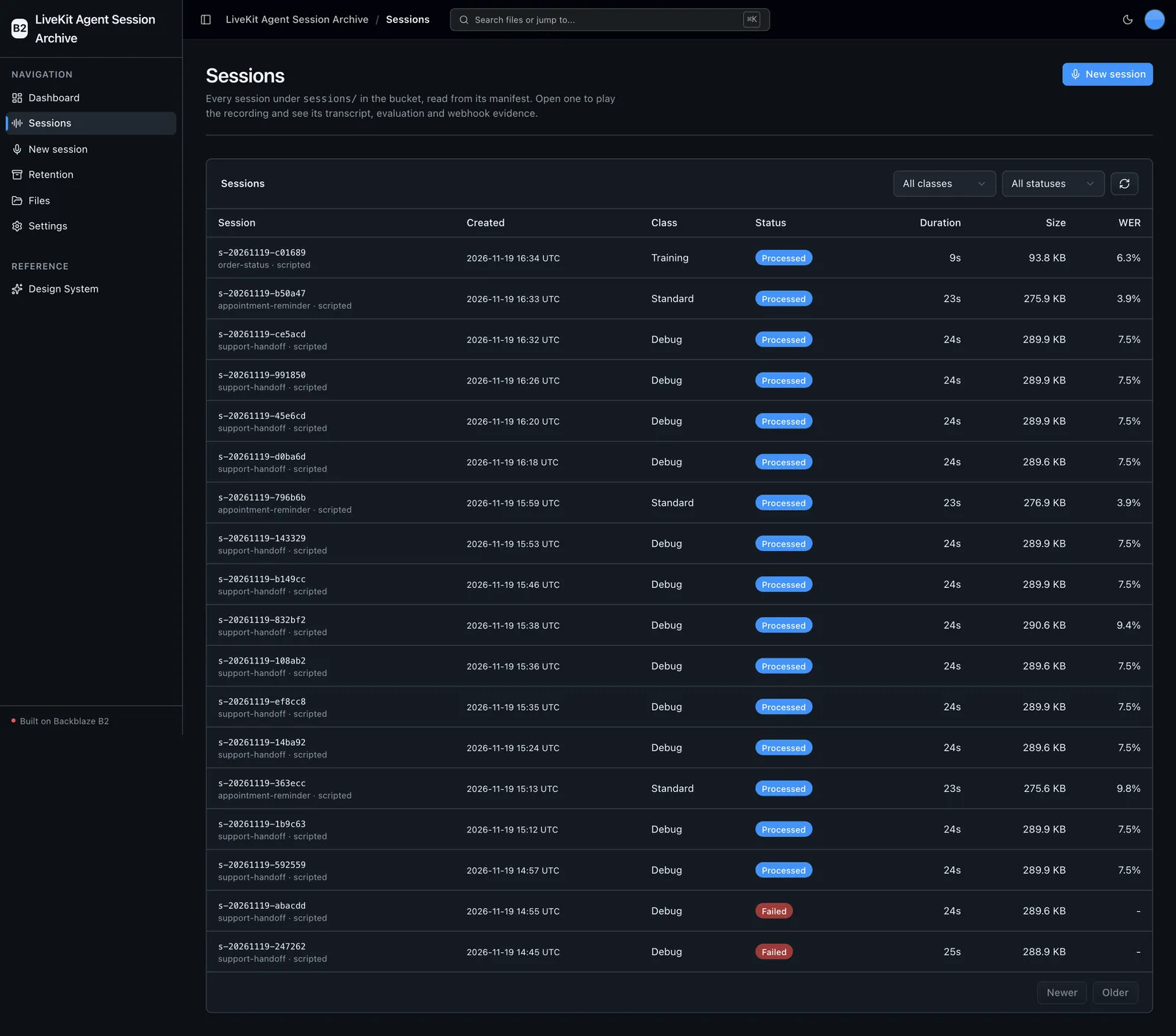
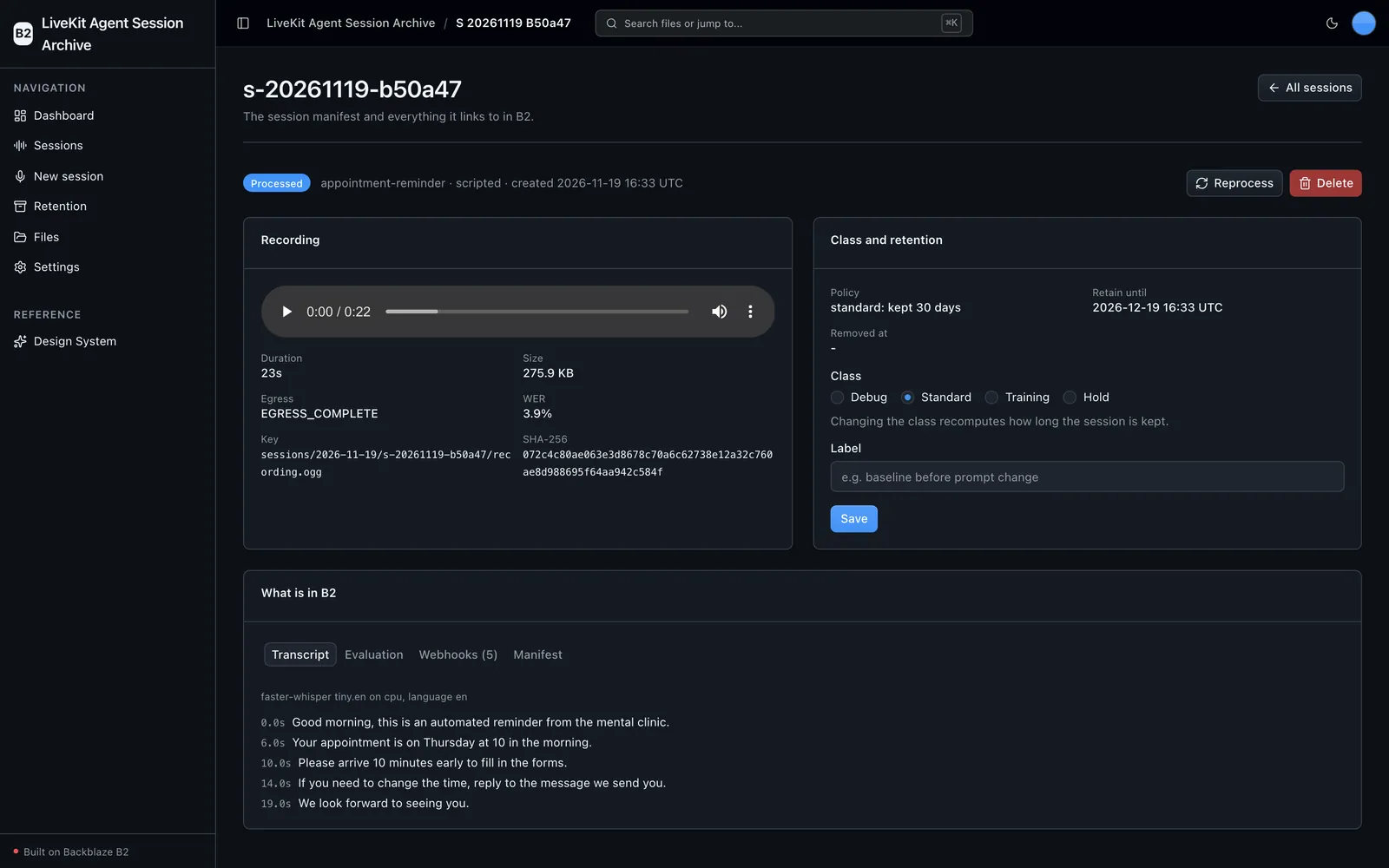
Browse sessions under sessions/, play recordings from B2, edit a session's class or label, reprocess or delete it.
Webhook manifests
Signed LiveKit webhooks are verified, deduplicated and stored as evidence, and keep each session's manifest current with the recording's location, size, duration and SHA-256.
Transcription and evaluation
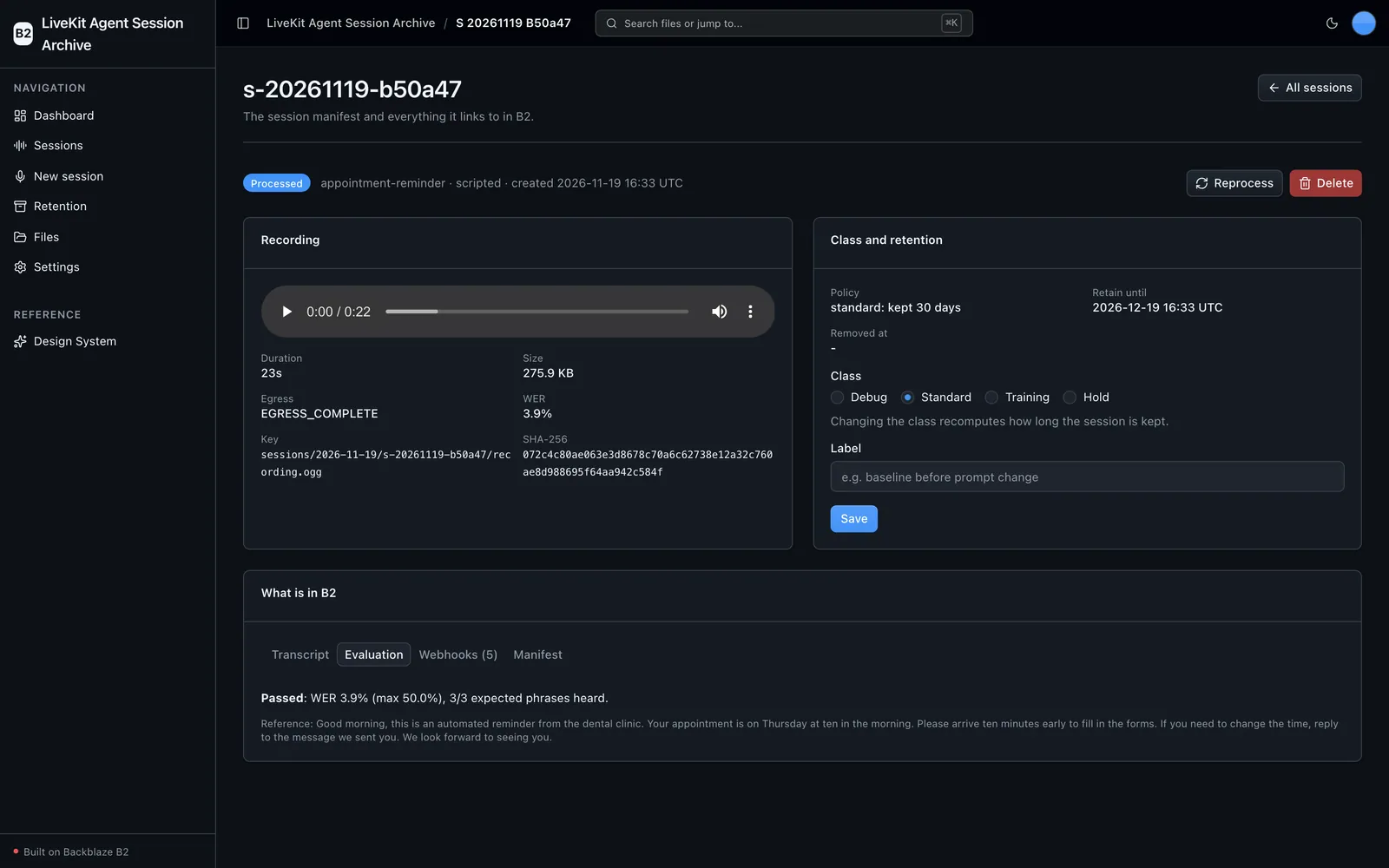
A local faster-whisper transcript plus a deterministic evaluation: word error rate against the script and an expected-phrase check.
Retention by class
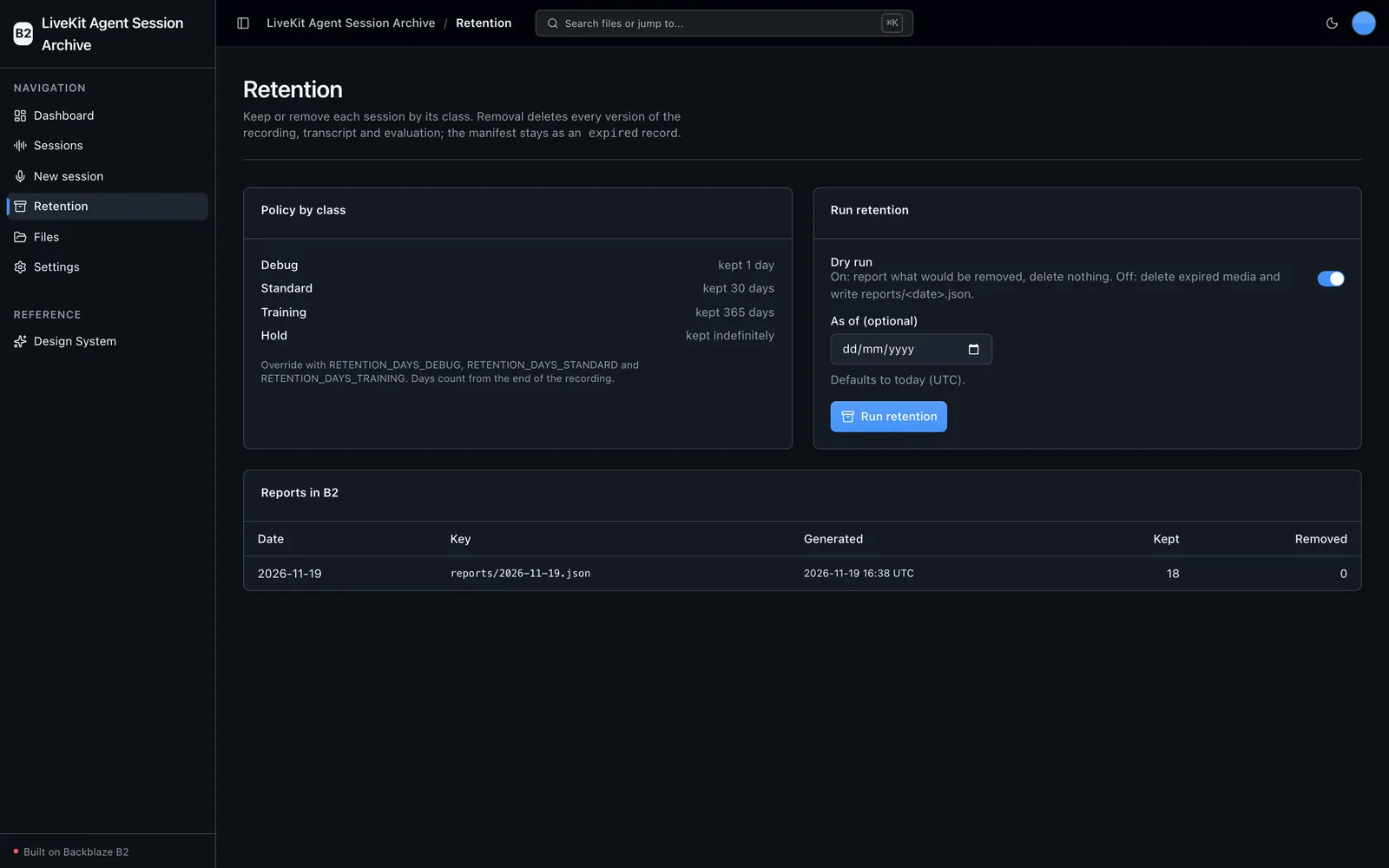
Keep or remove sessions by class (debug, standard, training, hold), deleting every object version so the bytes are gone, and write a per-day report to B2. Manifests and webhook evidence stay.
File browser
List, preview, download and delete any object in the bucket.
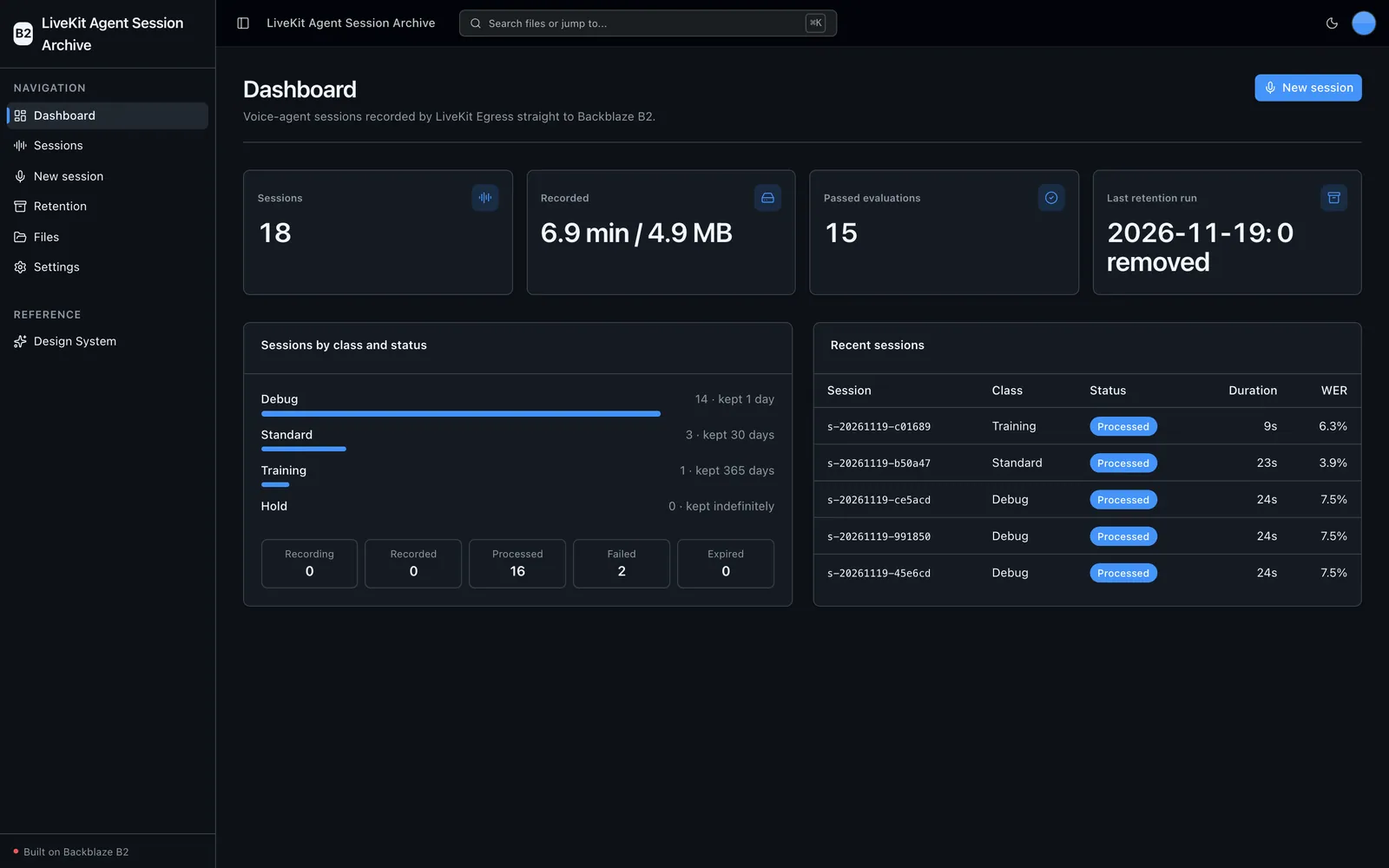
Dashboard
Sessions by class and status, recorded minutes and bytes, passed evaluations and the last retention run.
A closer look
More screens from the running project.
Choose it for the right job
LiveKit Agent Session Archive is a head start for a specific shape of project, not a supported, general-purpose product.
Use it when
- You run LiveKit Agents and need every session's recording, transcript and evaluation in one place you can query, keep and delete by policy.
- You want LiveKit Egress to write straight to S3-compatible storage, with a working, tested configuration for B2.
- You want a starting point for regression-testing an agent: the same script on every run, scored the same way.
- You want to preview retention with a dry run as of any date before applying it.
Choose another path when
- You need a production agent, telephony or call-center integration; the agent here is a scripted test fixture.
- You need compliance guarantees such as legal hold, consent capture or PII redaction; retention here is a cost and hygiene policy, not a compliance control.
- You want hosted speech-to-text or LLM evaluation; this sample is local only on purpose.
- You need authentication: the API is a local demo and anyone who can reach it can create and delete sessions.
- You need a serverless deployment; it runs as Docker Compose with long-lived LiveKit, Egress and Redis containers.
- You want an overview of voice AI storage patterns rather than one working app; see b2-voice-ai-reference-architectures.
Project status and support
Backblaze maintains this open-source sample to help developers get started with B2; report defects and requests through the repository's GitHub Issues. It has no service-level agreement (SLA) and no guaranteed support.