
OpenCLIP Batch Embeddings
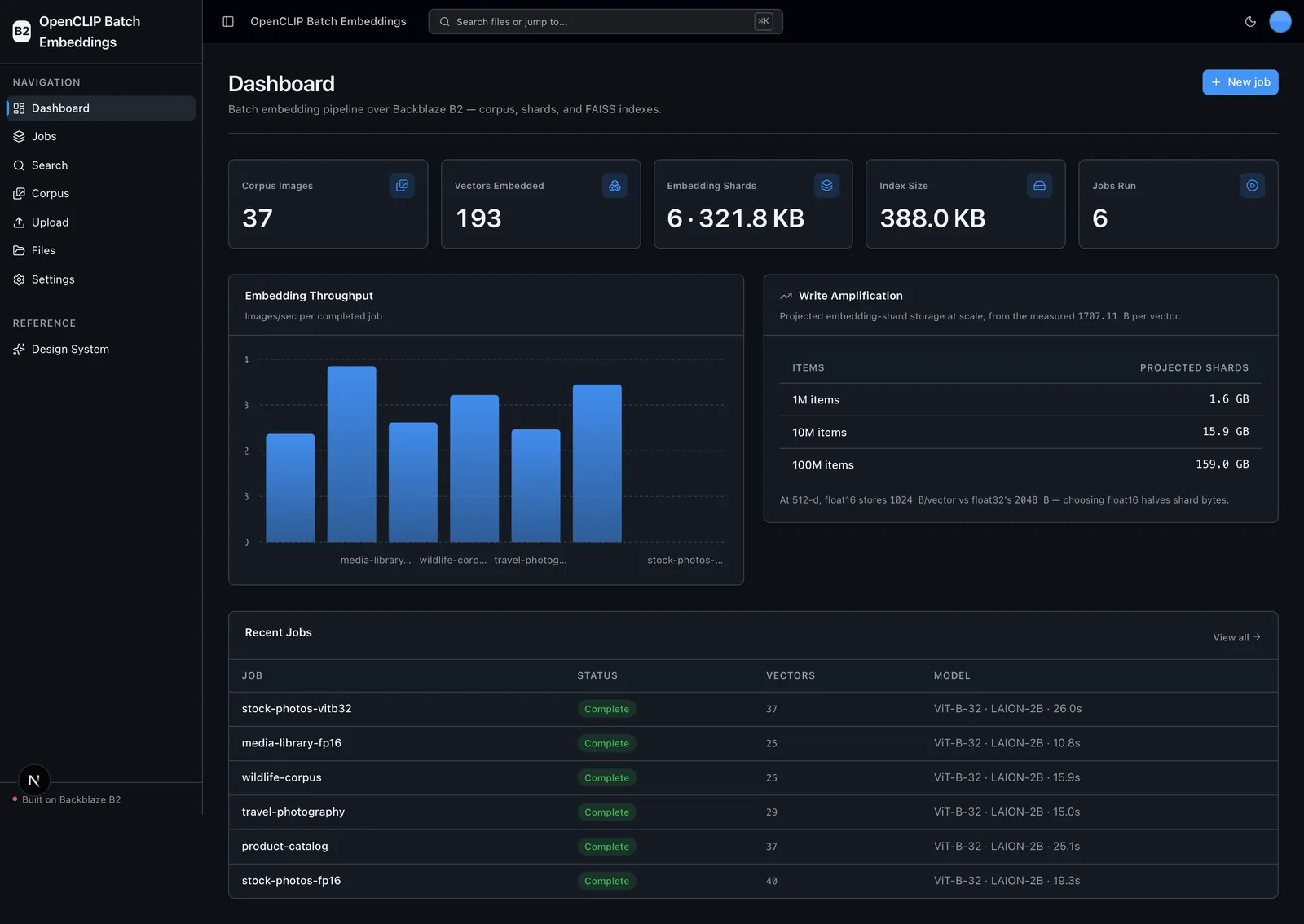
Batch-embed large image corpora with on-device OpenCLIP into a per-job FAISS vector index for text-to-image semantic search. Source images, .npy embedding shards, and the index all live on Backblaze B2 over the S3-compatible API, with no database and no external inference key.
Built for: Developers and ML engineers building semantic image search, near-duplicate removal, or dataset clustering who want Backblaze B2 as the durable store for the media, the embedding shards, and the vector index, with local key-free inference.
What it's built with
Each piece of the stack, and the job it does in this project.
- Next.js 16 + React 19
- Dashboard, jobs, search, corpus, files, and upload UI
- Tailwind CSS + shadcn/ui
- Design tokens and reusable interface primitives
- TanStack Query
- Client-side data fetching and cache management
- FastAPI + Pydantic
- Typed, layered Python API and configuration validation
- OpenCLIP (open_clip_torch + torch)
- On-device image and text embedding, no API key
- FAISS (faiss-cpu)
- Per-job vector index build and top-k search
- boto3 + Backblaze B2
- S3-compatible object storage for images, shards, and indexes
- pnpm workspaces
- TypeScript and Python monorepo workflow
Core capabilities
What the project does out of the box, before you write any code of your own.
Embedding jobs you can run
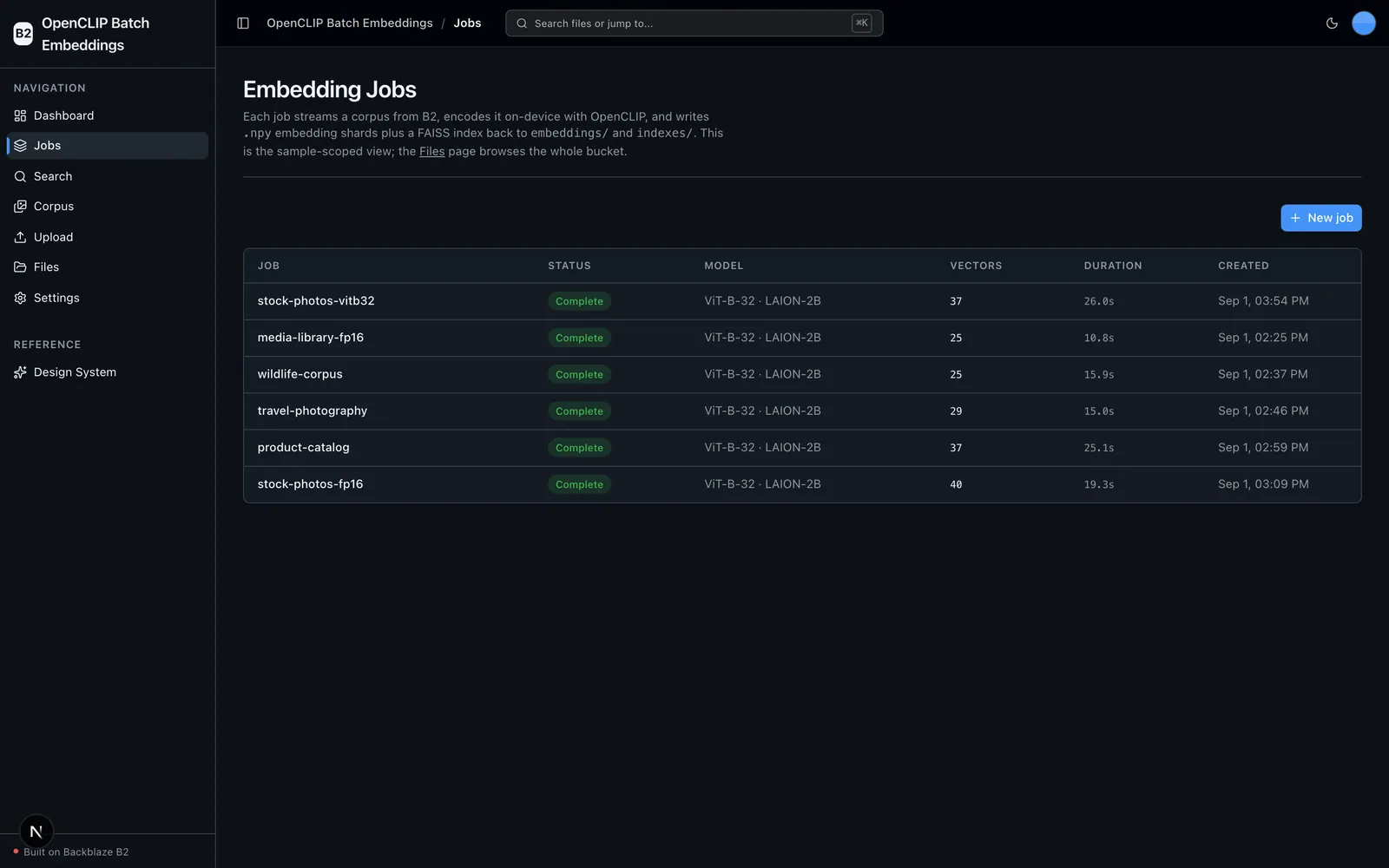
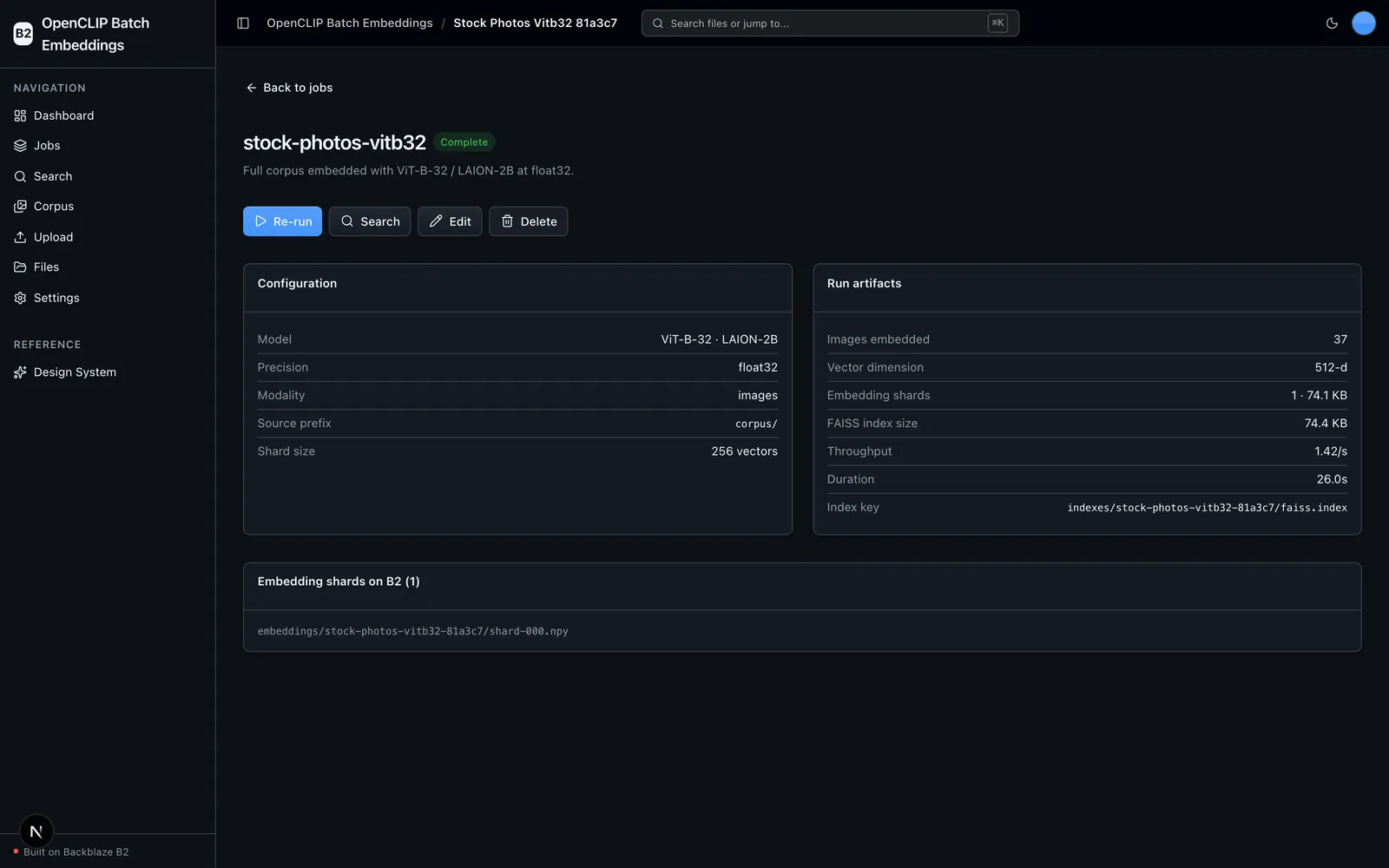
Create, edit, delete, and run batch embedding jobs, each with its own OpenCLIP model and float32 or float16 precision, locked once the job has run.
On-device batch CLIP pipeline
Stream images from B2, encode them locally with OpenCLIP (CUDA then Apple MPS then CPU autodetect, no API key), and write .npy embedding shards back to the bucket.
Per-job FAISS vector index
Build a FAISS index per job and upload it with its id map to indexes/<job>/ so any worker can reload the exact same vector space.
Semantic text-to-image search
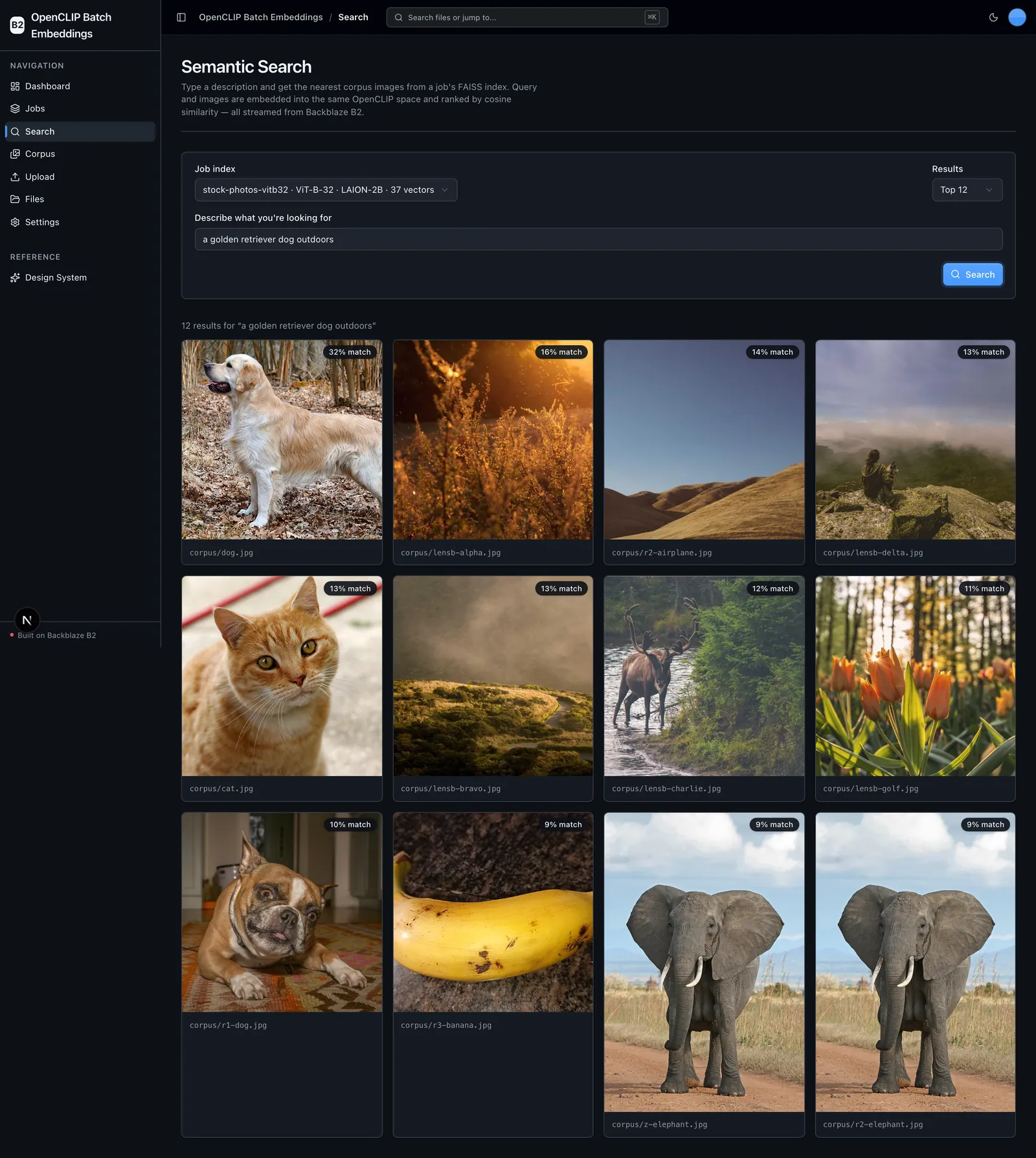
Embed a text query into the same OpenCLIP space, rank it against a job's index, and stream the top-k matching images straight from B2.
B2 as the sole store, no database
Source images, embedding shards, the FAISS index, and job manifests all live in one B2 bucket over the S3-compatible API; there is no separate database.
Reusable file browser and upload
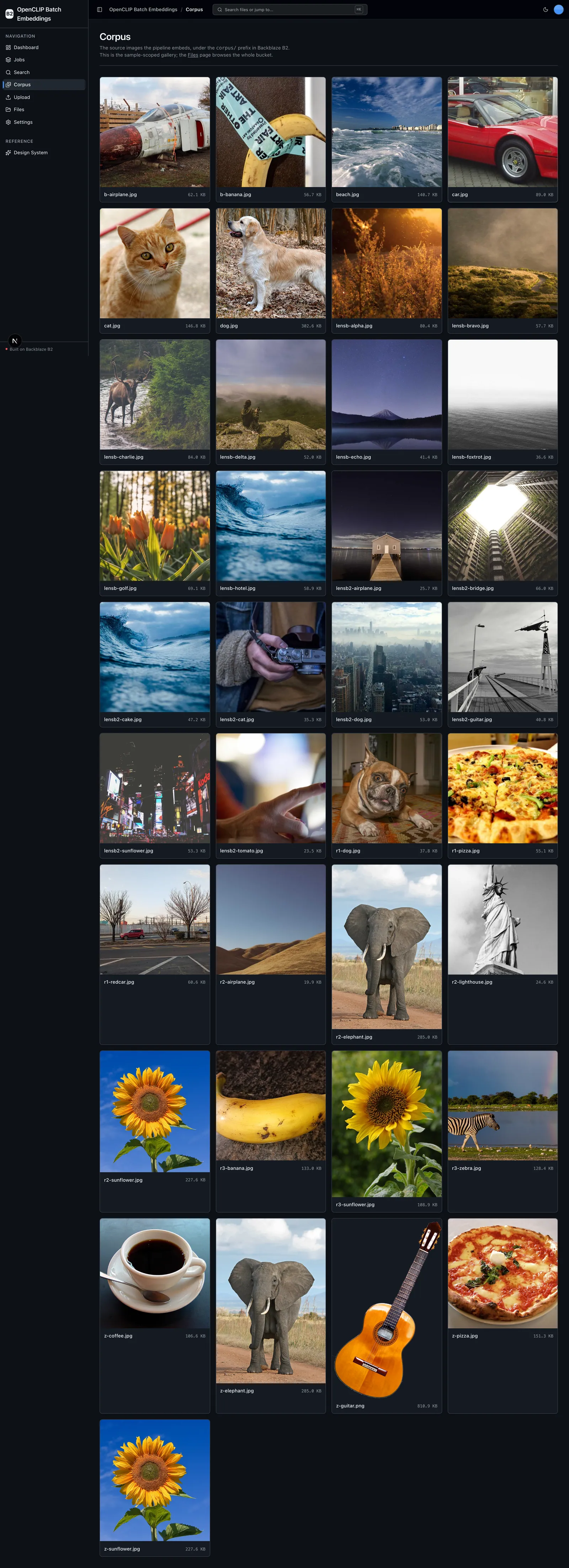
A full-bucket file browser and a bulk upload flow land images under corpus/ so they are immediately ready to embed.
A closer look
More screens from the running project.
Choose it for the right job
OpenCLIP Batch Embeddings is a head start for a specific shape of project, not a supported, general-purpose product.
Use it when
- You want to batch-embed an image corpus with on-device OpenCLIP and search it by text, with the create-job to run to search flow working end to end.
- You need source images, .npy embedding shards, and the FAISS index all stored durably in a single B2 bucket with no database to operate.
- You want to bulk-upload images and turn them straight into an embedding job from the UI.
- You want a reproducible, key-free reference you can run from a clean clone, since the default LAION OpenCLIP weights are ungated.
Choose another path when
- You need a managed vector database or hosted SaaS; this has no user accounts, authentication, tenant isolation, or billing.
- You are indexing billions of vectors and need a tuned approximate index; this favors an exact FAISS IndexFlatIP at demo scale.
- You want a one-click serverless deploy; torch and FAISS do not run on Vercel serverless, so you self-host the FastAPI service and own its operations, capacity, and index scaling.
- You want interactive single-image product search rather than batch corpus embedding; the clip-visual-product-search sample fits that better.
Project status and support
Report defects on the repository's GitHub Issues; this sample is maintained without a service-level agreement or guaranteed support.