
Qdrant Multitenant RAG Tiering
Full-stack sample (Next.js 16 + FastAPI) for multi-tenant RAG with Qdrant: hot tenants are served from Qdrant, idle tenants' collections are parked as verified snapshots in Backblaze B2 and restored on the next query, and a benchmark measures the latency cost and the memory saved.
Built for: Developers and AI coding agents running retrieval for many customers, most of them idle most of the time, who want to keep vector memory only for tenants that query and justify a parking threshold with measured restore cost.
What it's built with
Each piece of the stack, and the job it does in this project.
- Next.js 16 + React 19
- Web application and dashboard UI
- Tailwind CSS v4 + shadcn/ui
- Design tokens and reusable interface primitives
- TanStack Query + Recharts
- Client-side data fetching and latency and footprint charts
- FastAPI + Pydantic v2
- Typed, layered Python 3.12 API with the park and restore state machine
- Qdrant v1.20.2 + qdrant-client
- Hot tier: one collection per tenant, snapshotted and restored through Qdrant's snapshot API
- fastembed (BAAI/bge-small-en-v1.5)
- Local CPU embeddings, 384 dimensions, about 67 MB, no external AI calls
- boto3 + Backblaze B2
- S3-compatible durable tier: multipart snapshot uploads, manifests, corpora, and benchmark reports
- pnpm workspaces + Docker Compose
- Monorepo workflow and a three-container local stack
Core capabilities
What the project does out of the box, before you write any code of your own.
Tenants
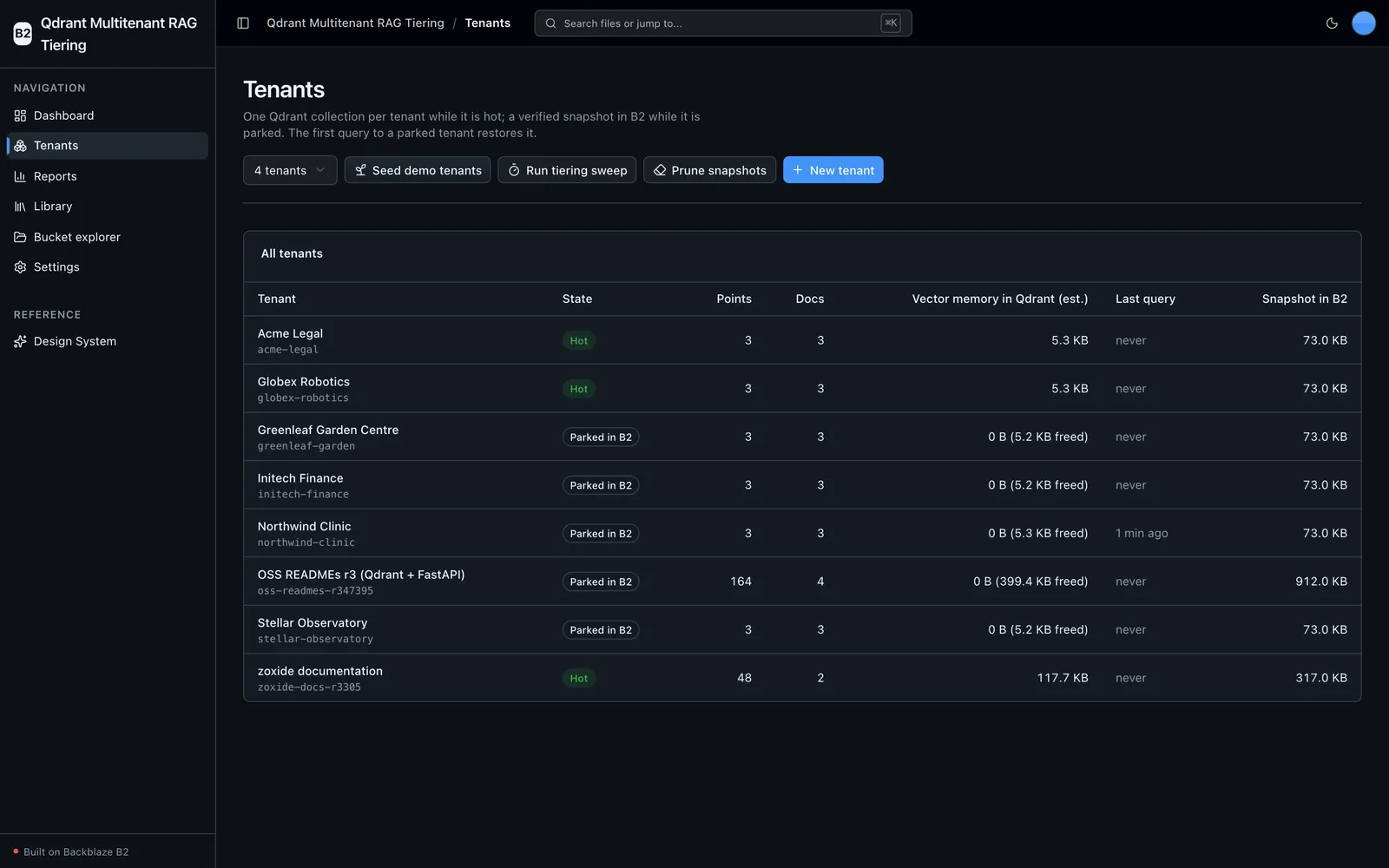
Create tenants from text or Markdown files, or seed demo tenants; each gets its own Qdrant collection, with its source corpus stored in B2.
Tiering with verify-before-drop
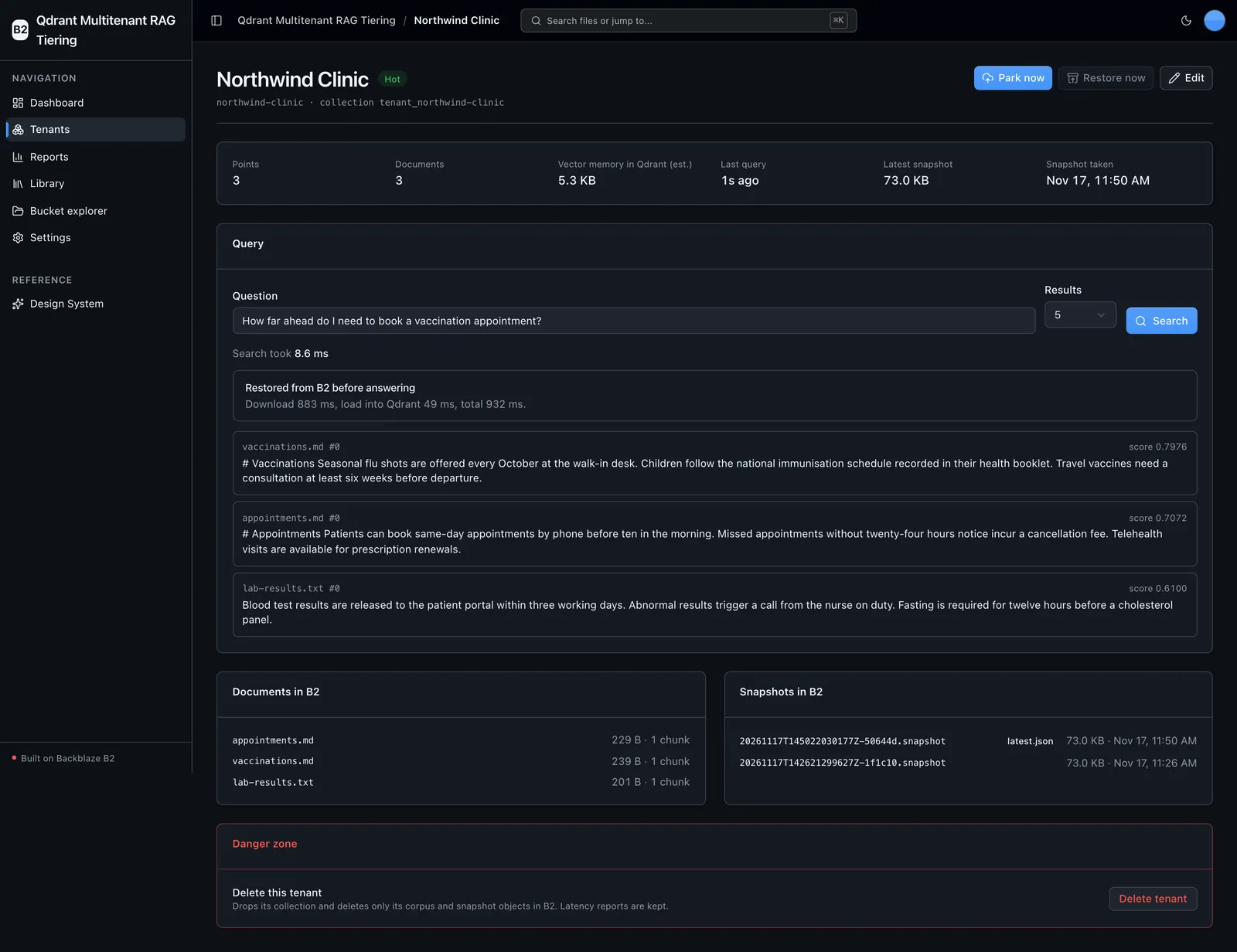
An idle policy or a manual Park now snapshots the collection, streams it to B2 with a multipart upload, writes the manifest last, verifies size and sha256 in B2, and only then drops the collection.
Restore on query
The first query to a parked tenant restores its snapshot from B2 into any Qdrant node, including an empty one, checks the hash and point count, and reports the restore cost.
Latency report
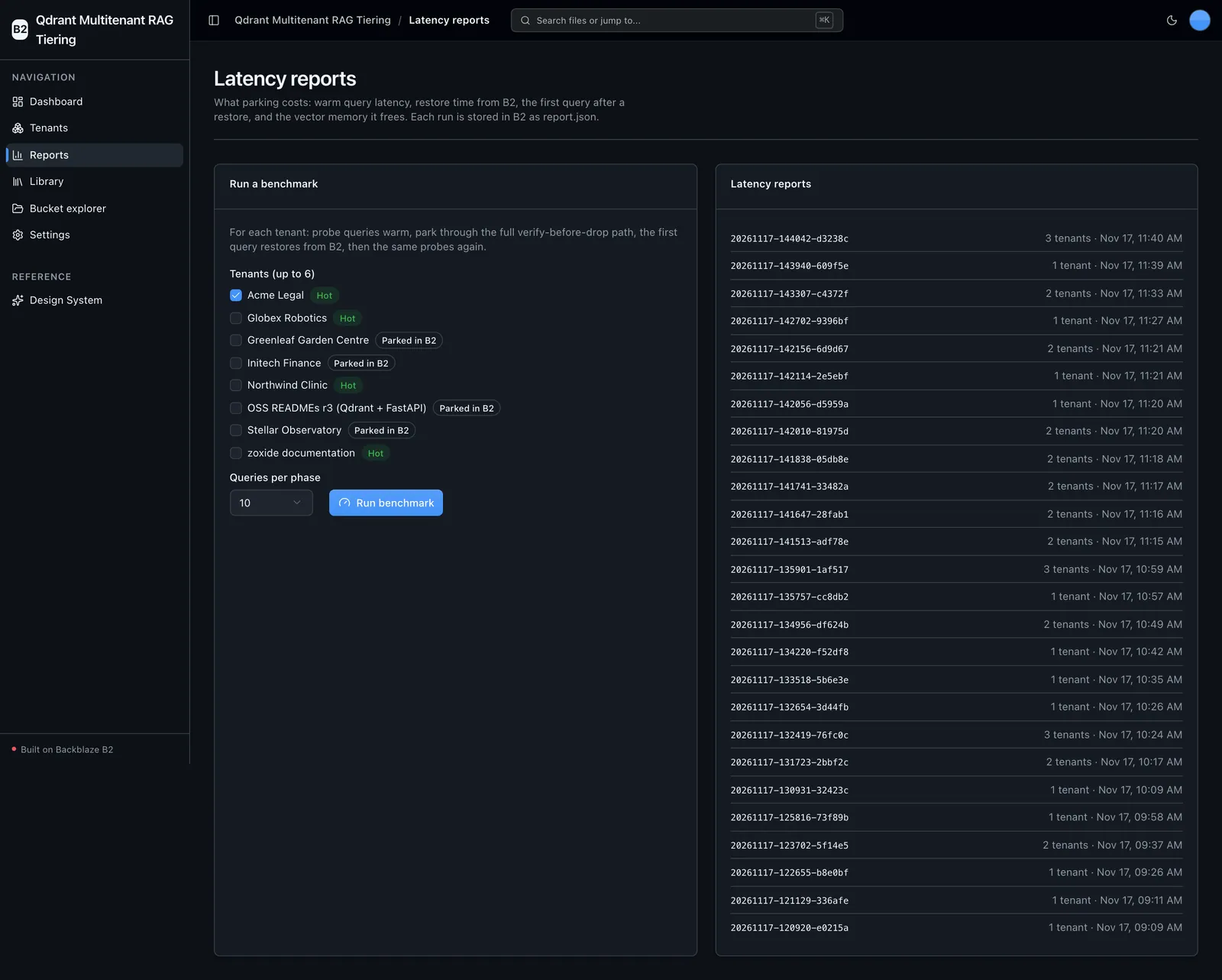
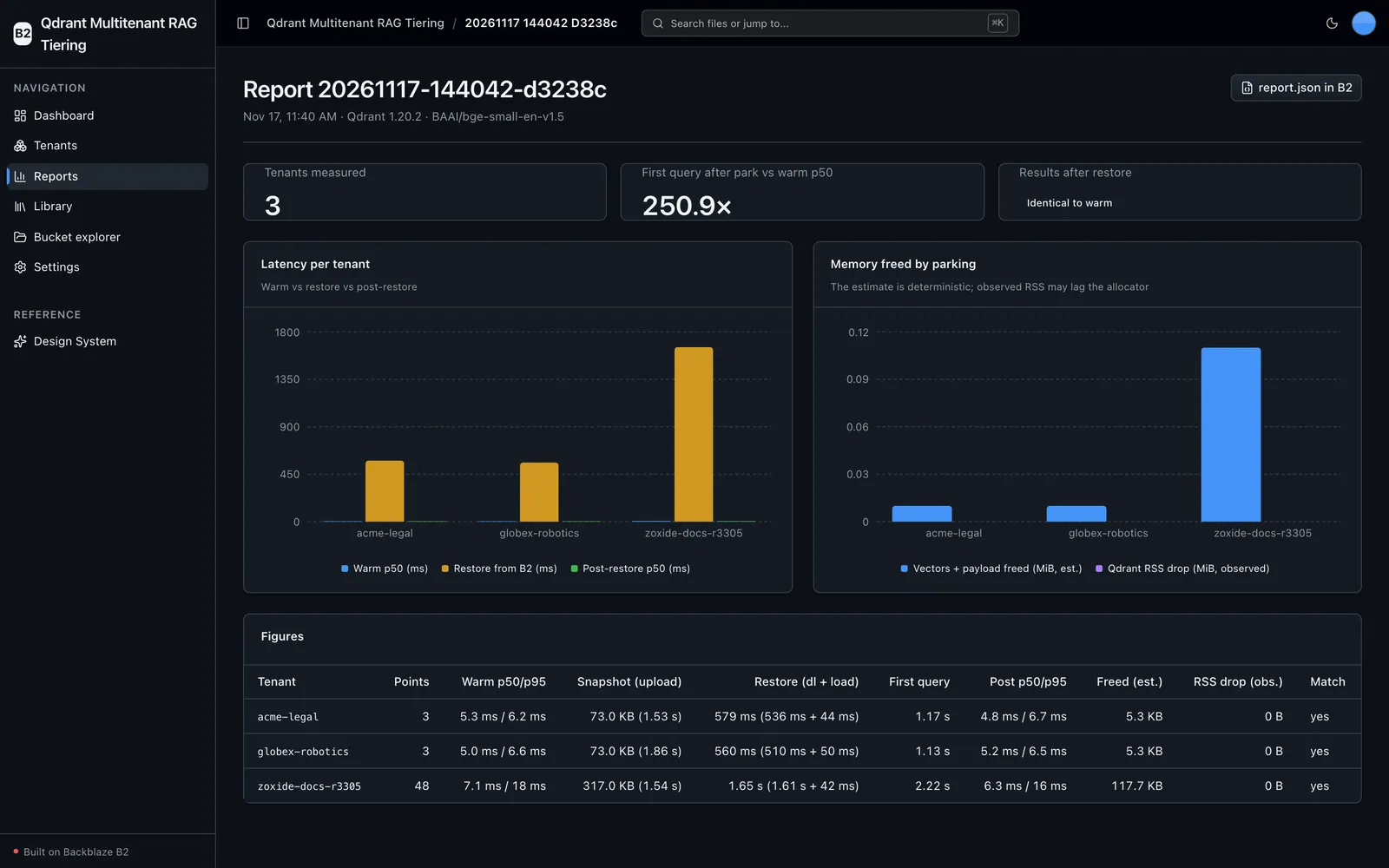
Benchmark warm, restore, first-query and post-restore latency plus memory freed for selected tenants, stored as report.json in B2 with a result-match check.
Dashboard
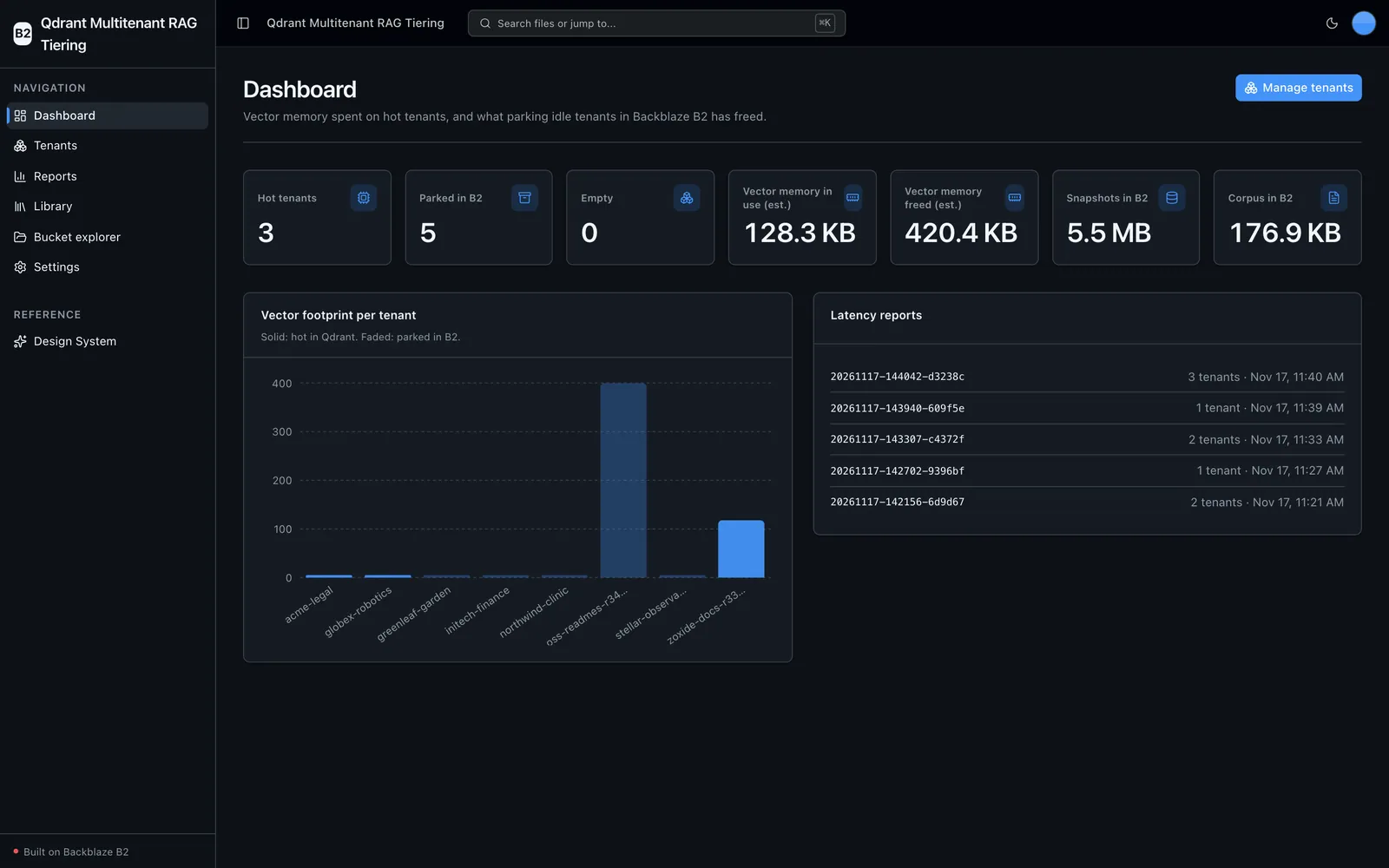
Hot, parked and empty counts, vector memory in use and freed, bytes in B2, a per-tenant footprint chart and recent reports.
Library and Bucket Explorer
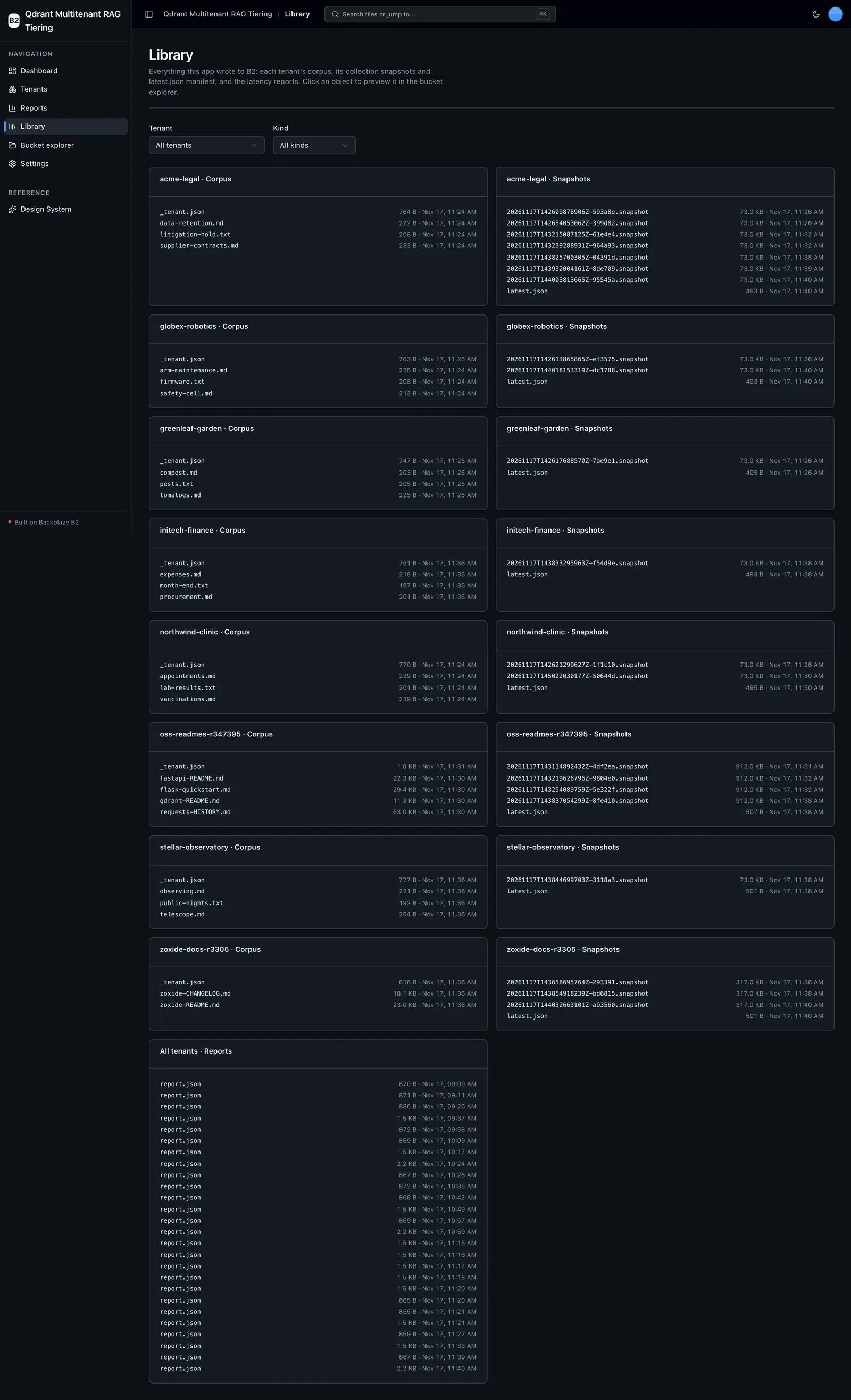
Browse the app's own objects under rag/ grouped by tenant and kind, or the whole bucket with preview, download and delete streamed through the API.
A closer look
More screens from the running project.
Choose it for the right job
Qdrant Multitenant RAG Tiering is a head start for a specific shape of project, not a supported, general-purpose product.
Use it when
- You run retrieval for many customers with one Qdrant collection per tenant and most tenants are idle most of the time.
- You want idle tenants' vector memory freed while their collections stay recoverable as verified snapshots in Backblaze B2.
- You need measured warm latency, restore time and post-restore latency to choose a parking threshold on numbers rather than guesses.
- You want a worked example of streaming large artifacts to B2 safely: multipart upload, manifest last, verify before delete.
Choose another path when
- You need a hosted multi-user service: the API has no authentication or tenant-scoped access, and its per-tenant locks assume one API process per Qdrant node.
- You run Qdrant clusters with replicated shards or payload-based multitenancy inside a single collection; neither is covered.
- Your tenants are so large that a restore takes minutes, or you want a serverless deploy: the sample needs a Qdrant node and a CPU embedding model, so it runs with Docker Compose.
Project status and support
Report defects and feature requests through the repository's GitHub Issues; the sample carries no SLA.